Refractory wear is unavoidable in aluminium smelting, but a full rebuild is not always the right response. Cracks, spalled surfaces, and open joints often develop in isolated areas long before the surrounding lining reaches the end of its service life. Moldable refractories, formable high-temperature materials, are well suited to repairing those issues because they can be packed, shaped, and sealed directly into damaged sections without disturbing stable refractory nearby.
THERMOSEAL® Refractory Moldables for aluminium smelter repairs
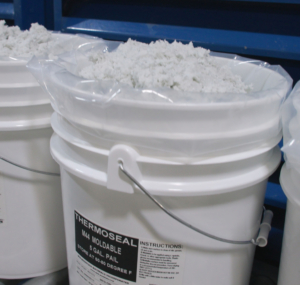
THERMOSEAL® Refractory Moldables from Mid-Mountain Materials, Inc. are designed for high-temperature insulation, sealing, coating, and patching. Their value in aluminium processing comes from pairing repair flexibility with thermal performance. Depending on the grade, continuous-use limits reach 2300°F (1260°C). Low shrinkage supports dimensional stability after installation, thermal shock resistance helps repairs endure repeated heating and cooling, and selected non-wetting moldable refractories limit molten aluminium penetration.
Because damage varies by location, Mid-Mountain Materials, Inc. offers moldable refractories in several consistencies:
- THERMOSEAL® M22- available as a dry mix or pumpable paste for void filling, surface coating, and refractory lining repair
- THERMOSEAL® M33 and M44- pliable non-wetting putties for hand packing, joint sealing, cathode bar seals, and collector bar window seals
- THERMOSEAL® T22- a wet tamping mix for repairs needing firm consolidation during placement.
Why moldable refractories work well for aluminium smelter refractory patching
Adaptability around irregular geometries and complex interfaces
Localized wear in aluminium smelters seldom leaves a neat cavity. A spalled furnace wall may have feathered edges, and a collector bar window can combine tight corners with narrow gaps around metalwork. Brick and precast shapes are difficult to fit into such spaces without removing sound material. Moldable refractories follow the existing geometry, allowing technicians to pack the repair into the damaged profile and maintain close contact with the surrounding lining.
Around cathode and collector bar interfaces, close fit also limits air ingress into hot zones. Oxygen reaching exposed cathode carbon can accelerate oxidation and enlarge the repair. Pliable grades such as THERMOSEAL® M44 can seal penetrations and irregular edges, closing those paths and reinforcing the thermal barrier.
Non-wetting resistance against molten aluminium
Molten aluminium poses a different threat because it can penetrate porous refractory surfaces and attack material below the hot face. Once metal enters cracks or open pore structures, damage can spread beyond the visible defect. Non-wetting moldable refractories reduce the tendency of aluminium and slag to adhere to the repair, helping limit penetration and protect the refractory layers behind it.
In transfer troughs, launders, furnace walls, and splash zones, reduced adhesion can ease routine cleaning. Slag and frozen metal are less likely to grip the repaired surface as strongly, so crews can remove deposits with less mechanical disturbance to the patch.
Resistance to thermal cycling and shock
Temperature movement can be as damaging as temperature level in aluminium processing equipment. Furnace shutdowns, heat-up periods, and changing process conditions repeatedly expand and contract the lining. A patch that shrinks excessively or loses contact at its edges can reopen a route for heat, air, or molten aluminium.
Moldable refractories formulated for low shrinkage and thermal shock resistance can ensure repaired areas remain stable through those cycles. Close contact with adjacent refractory is most important at joints and penetrations, where a small opening can weaken the seal and shorten the interval before another repair.
Reduced downtime through focused application
Large refractory rebuilds involve demolition, waste removal, replacement, drying, and controlled heat-up. Such work is necessary when a furnace, trough, ladle, or reduction cell lining reaches the end of its service life, but it can be disproportionate when damage is confined to one zone. Moldable refractories let crews concentrate labor on the area that has deteriorated.
Application methods can be matched to access and geometry. Crews may use trowels, spatulas, hand packing, caulking equipment, pumping systems, or tamping methods according to the selected grade. Surface preparation, drying, and heat-up are still important; however, a smaller repair scope can make planned maintenance easier to schedule and help defer a larger outage.
Heat containment and energy efficiency
Open joints and damaged refractory give process heat a path toward steel shells, structural components, and the surrounding work area. As heat escapes through weak points in furnace walls, trough interfaces, or bar penetrations, shell temperatures can rise, and more energy may be needed to maintain aluminium processing temperatures.
Insulating moldable refractories restore continuity across cracked joints, bar openings, trough interfaces, and damaged wall sections. Closing localized heat-loss paths protects nearby components and keeps more thermal energy inside the process. For maintenance teams, moldable refractories can support asset protection and heat management within the same maintenance strategy.
Supporting aluminium smelter refractory maintenance
Mid-Mountain Materials, Inc. manufactures THERMOSEAL® Moldable Refractories for sealing, coating, lining repair, and patching across demanding aluminium processing equipment. Our range includes dry mixes, pumpable materials, pliable putties, non-wetting grades, and wet tamping products, supported by high-temperature fabrics, cements, coatings, and thermal barrier materials for severe industrial service. Contact Mid-Mountain Materials, Inc. to discuss furnace interfaces, trough linings, cathode bar seals, collector bar windows, or other refractory problem areas and find a THERMOSEAL® product that fits the repair.