
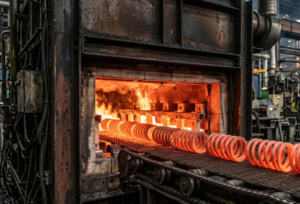
Energy moves relentlessly inside a furnace through radiation, convection, and direct contact. Without defined barriers between temperature zones, that energy spreads beyond its intended boundaries, disrupting thermal balance and process consistency. Over time, uncontrolled heat transfer complicates temperature control and impacts product quality. Heat shields engineered for use as furnace heat zone dividers help manage the pathways of thermal energy, generating reliable thermal separation without sacrificing throughput or operational continuity.
The Necessity of Isolation in Thermal Processing
Maintaining isolation between temperature zones is critical to controlled thermal processing. In multi-zone furnaces, radiant heat and high temperature combustion gases naturally migrate from hotter chambers into cooler downstream zones when internal boundaries are insufficiently defined. This uncontrolled heat migration alters localized thermal conditions, affecting metallurgical transformations, reaction kinetics, and the stability of controlled cooling stages.
Heat shields that are utilized as furnace heat zone dividers are designed to counteract such behavior by establishing a stable, engineered thermal break between adjacent zones. By restricting radiant heat transfer and limiting convective gas movement at zone interfaces, these dividers preserve intended temperature differentials. As a result, each furnace zone can maintain its target thermal profile with greater consistency, supporting tighter process control and more predictable furnace performance.
How Heat Shields Operate as Furnace Heat Zone Dividers
When heat shields function as effective furnace heat zone dividers, they act as active thermal boundaries that regulate how heat moves between adjacent zones. Their control of the primary mechanisms of heat transfer and gas movement within the furnace allows temperature transitions to remain stable and predictable during operation, even under continuous loading and changing process conditions.
At zone interfaces, heat shields redirect radiant energy back toward high-temperature sections, restrict the convective flow of hot gases into cooler zones, and limit gas exchange between adjacent furnace stages. Such coordinated control reduces heat bleed, stabilizes temperature differentials, and helps prevent downstream temperature drift that can disrupt controlled heating or cooling sequences.
From an operational standpoint, the effects of heat shields translate directly into improved process consistency. Defined thermal and atmospheric boundaries enable furnace heat zone dividers to support tighter temperature control, reduce cycle variability, and improve zone-level reliability. The outcome is a more stable furnace environment that enables repeatable performance across complex, multi-zone thermal processes.
How Heat Shields Are Used as Dividers
Heat shields can be implemented in several configurations, depending on furnace design and operating requirements:
- Curtain configurations- A weighted, flexible heat shield curtain is suspended between adjacent furnace temperature zones. When workpieces or materials pass through the divider, the curtain flexes inward to allow passage and then returns to its closed position, re-establishing the thermal barrier with minimal delay.
- Baffle systems- Heat shields are installed as fixed internal baffles, rigid barriers positioned within the furnace to redirect airflow, preventing hot gases from circulating into lower-temperature areas.
- Seal and gasket integration- Heat shields are integrated into door seals or gasketed transition points, where compressible materials conform to adjacent surfaces to maintain an airtight furnace heat zone divider under internal pressure and high-velocity burner airflow.
These configurations allow heat shields to be adapted to both new furnace designs and existing systems, providing flexibility in how thermal boundaries are introduced and maintained within complex thermal processing systems.
Mid-Mountain Materials: Engineering Heat Shields for Furnace Heat Zone Dividers
Developing a robust furnace heat zone divider requires materials that combine high-temperature resistance with mechanical durability and flexibility. At Mid-Mountain Materials, Inc., we develop and supply engineered textile materials that can support the performance of heat shields used as furnace heat zone dividers, offering performance characteristics that enable the control of heat transfer, airflow, and mechanical interaction at furnace zone interfaces.
Our silica and fiberglass fabrics are suitable for heat shield applications in multi-zone furnaces. Silica fabrics tolerate sustained exposure to extreme temperatures, making them appropriate for high-temperature zones where long-term thermal stability is required. Fiberglass fabrics provide a durable and flexible foundation for applications that involve repeated contact, flexing, or abrasion as products move through zone transitions, such as flexible divider curtains in continuous furnaces.
The performance of heat shield materials utilized as furnace heat zone dividers is further refined through the use of application-specific coating technologies, which allow these materials to be adapted to different furnace conditions. Each coating addresses a specific thermal or mechanical requirement at the furnace heat zone interface. Vermiculite coatings enhance heat resistance and surface durability, making them useful for high-temperature furnace environments. ARMATEX® Firestar combines a fiberglass substrate with a vermiculite coating to improve flame resistance and thermal insulation in furnace heat zone divider applications. Moreover, silicone coatings are used where additional flexibility and moisture resistance are required, particularly in lower-temperature zones or areas exposed to variable operating conditions. Ceramic coatings, by contrast, introduce an additional refractory layer, offering increased thermal protection for furnace heat zone divider materials exposed to higher heat loads or more aggressive furnace environments.
The combination of these substrates and coatings ensure furnace heat zone dividers can be engineered to perform reliably under continuous heat exposure, mechanical contact, and internal pressure conditions.
Solving Thermal Challenges with Mid-Mountain Materials, Inc.
The silica, fiberglass, and ceramic-based textiles from Mid-Mountain Materials, Inc. are fabricated with application-specific coatings to support reliable thermal separation in demanding furnace environments. Such material systems underpin SILTEX® and ARMATEX® Coated Fabrics solutions used in heat shield applications, where stable temperature control and process consistency are critical. Reach out to us to evaluate heat shield material options tailored to your furnace design, temperature requirements, and operating parameters.