
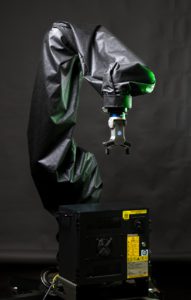
Welding environments place extreme demands on nearby equipment. Radiant heat from the arc, elevated ambient temperatures, and constant molten metal spatter generate conditions that can quickly degrade cables, joints, sensors, and seals on robotic and mechanized systems. While industrial robots are engineered for precision and repeatability, they are not designed to tolerate direct exposure to welding heat and spatter. A robot protective cover provides the critical barrier between these harsh conditions and the robot’s sensitive components. Its effectiveness depends on its ability to block radiant heat and shed molten spatter before either can transfer damaging energy to the robot beneath. How a robot protective cover achieves this balance of heat resistance and spatter shedding depends on the materials chosen to withstand welding temperatures and on how those materials are engineered into a functional protective system.
How a Robot Protective Cover Withstands Welding Heat
High-Temperature Base Fibers Resist Thermal Breakdown
A robot protective cover withstands welding heat by using fibers that remain dimensionally stable at temperatures far beyond the limits of standard industrial fabrics. High-temperature materials, such as fiberglass and aramid resist melting, shrinking, tensile strength loss, and thermal breakdown when exposed to radiant welding heat. Because the fibers maintain their structural integrity through repeated heating and cooling cycles, the robot protective cover retains its protective geometry over time instead of stiffening or becoming brittle. This consistency is vital for retaining reliable coverage in high-heat zones near the weld arc, where thermal exposure is continuous and extreme.
Insulating Fabric Construction Limits Heat Transfer
Beyond resisting surface exposure to welding heat, a robot protective cover must also manage how much thermal energy it absorbs and transmits during welding operations. The insulating fabric construction of the robot protective cover uses carefully controlled thickness and density to slow the flow of radiant welding heat through the cover, reducing the temperature rise within the fabric layers themselves. Such insulation limits heat accumulation during high-duty welding cycles, where repeated exposure can otherwise drive the material toward thermal breakdown and loss of flexibility. By controlling internal fabric temperatures, the insulating construction allows robot protective covers to withstand prolonged welding heat while continuing to protect the robot’s motors, cables, and seals from cumulative thermal stress.
Articulated Design Prevents Conductive Heat Buildup
Possessing an articulated design allows a robot protective cover to withstand welding heat through maintaining controlled separation between the cover and hot robot surfaces throughout motion. Features such as bellows, pleats, and expansion zones enable the robot protective cover to move freely with joints, housings, and axes without pulling tight or collapsing against heat sources. This clearance limits conductive heat transfer and prevents localized heat concentration at contact points. As a result, robot protective covers can maintain uniform thermal protection across complex and repetitive motion paths and safeguard seals, bearings, and other temperature-sensitive components.
Controlled Venting Supports Internal Heat Release
Robots generate their own operational heat during continuous motion, particularly in high-load or high-speed applications. Integrated ventilation zones in the robot protective cover allow internally generated heat to escape without generating direct exposure paths for welding heat. When properly positioned, these vents support stable internal temperatures and preserve the integrity of the external barrier, preventing overheating while avoiding sacrificing external protection.
How a Robot Protective Cover Withstands Welding Spatter
Low-Energy Surface Coatings Prevent Adhesion
Specialized surface coatings ensure robot protective covers have a low surface energy exterior that resists welding spatter adhesion. Silicone- and fluoropolymer-based coatings make molten spatter less likely to stick to the fabric, even during processes that generate heavy or erratic spatter. Limiting adhesion at the outer surface of the robot protective cover prevents spatter build-up that would otherwise concentrate heat and accelerate fabric wear.
Rapid Spatter Shedding Minimizes Thermal Damage
On a low-energy surface, molten welding spatter beads up and falls away instead of spreading across the robot protective cover. This rapid release shortens contact time and limits localized heat input into the fabric. By preventing spatter from lingering on the cover surface, the risk of burn-through, fabric stiffening, and brittle area formation is reduced. Over time, reliable spatter release contributes directly to longer service life.
Sacrificial Design Absorbs Repeated Impact
In welding environments, robot protective covers are designed to serve as sacrificial layers. Repeated impacts from welding spatter, surface abrasion, and incidental contact are absorbed by the cover rather than the robot’s cables, seals, and joints. Planned replacement of the robot protective cover establishes a predictable maintenance cycle and helps prevent costly damage to primary robotic components, supporting higher uptime and steadier production.
Coatings Preserve Flexibility and Fabric Integrity
Embedded welding spatter can harden within a fabric weave and restrict movement, particularly in high-flex areas such as wrists and elbows. Protective coatings prevent this embedding through allowing spatter to release cleanly from the surface of robot protective covers. Consequently, the fabric remains flexible, compliant, and resistant to cracking even after prolonged exposure to welding spatter and repeated articulation.
Reliable Robot Protection for Welding Applications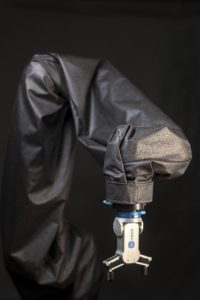
Effective protection for industrial robots in welding environments requires more than a heat-resistant fabric. It demands a robot protective cover system that integrates high-temperature fibers and an insulating construction, articulated design, and spatter-resistant surface chemistry. At Mid-Mountain Materials, Inc., robot protective covers are engineered using this complete approach, incorporating ARMATEX® Coated Fabrics, specifically ARMATEX® Robotex SBN 13-602, and application-specific designs. The result is reliable protection that preserves robotic accuracy, reduces unplanned downtime, and safeguards the long-term return on welding automation investments. To learn more about our materials for robot protective covers, reach out to our experts today to discuss your requirements.