
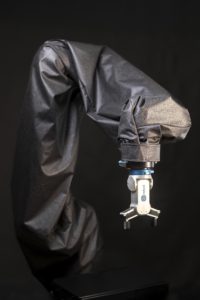
Industrial automation is often deployed where personnel cannot work safely, including within weld cells, foundries, and high-heat fabrication lines. In these environments, industrial robots rely on protective covers to shield critical components, like motors and sensors, from thermal damage. Although robot structures can tolerate harsh conditions, internal electronics, seals, lubrication systems, and cable assemblies fail at temperatures far lower than those produced by flame, weld spatter, and molten slag, resulting in unexpected shutdowns, increased maintenance intervals, and reduced production throughput. Testing thermal barriers in high-temperature robot protective cover designs is therefore necessary to confirm that a cover can sustain a stable micro-environment during continuous operation under real-world conditions.
Understanding the Thermal Threats to Robot Protective Covers
Fire and Flash Heat Exposure
Robot protective covers in welding and metal processing environments are rarely exposed to steady heat alone. Instead, they encounter elevated ambient temperatures combined with intermittent flame or flash heat from arcs, torches, or furnaces. Such a mix of sustained and transient heat loads places unique stress on thermal barriers used in robot protective cover designs.
Standardized thermal qualification testing for robot protective covers must confirm that cover materials tolerate both sustained exposure and short-duration temperature spikes. This type of testing is intended to identify failure modes that do not appear under steady heat alone, since materials that perform well under constant exposure often fail during brief, high-intensity thermal events. By evaluating cracking, ignition, and excessive inward heat transfer during these transient conditions, thermal barrier qualification testing establishes if a robot protective cover can maintain its protective function in service.
Weld Spatter as a Point-Source Load
Weld spatter is one of the most aggressive threats faced by robot protective covers. Each droplet of molten metal delivers concentrated thermal energy to a small surface area, and whether that energy is transferred into the cover is governed by the surface’s wetting behavior. Thermal barrier testing for robot protective covers must consider surface wetting behavior, since molten metal that wets the surface spreads and maintains contact, increasing heat transfer into the barrier layers. Coatings that resist wetting promote spatter shedding, which limits thermal conduction and must be verified through impact-based testing under representative welding conditions.
Slag Accumulation Over Time
Slag presents a slower but equally damaging challenge for robot protective covers. Over long production cycles, slag can accumulate on seams, folds, and horizontal surfaces. Once established, the resulting slag deposits form a conductive bridge that steadily transfers heat through the thermal barrier. Testing thermal barriers in robot protective cover designs must evaluate long-duration exposure scenarios, in which slag build-up acts as a conductive path that increases internal temperatures.
Thermal Qualification Methods for Robot Protective Cover Designs
High-temperature robot protective cover designs must account for multiple thermal stresses acting simultaneously, including sustained ambient heat, transient flame exposure, and direct contact with molten metal. As a result, thermal testing used during the design process must replicate combined operating conditions rather than evaluating materials in isolation.
- ASTM F955, Evaluation of Heat Transfer- measures temperature rise behind a fabric during molten metal exposure. When applied during high-temperature robot protective cover design, this test quantifies resistance to burn-through and internal overheating near joints, motors, and cabling, where thermal sensitivity is highest.
- ASTM D6413, Flame Resistance- evaluates after-flame time and char length. The use of this testing in robot protective cover design confirms that selected materials self-extinguish and do not propagate flame, ensuring the cover does not become an additional heat source under flash or flame exposure.
- Thermal conductivity testing- typically conducted using guarded hot plate methods, this determines the rate of heat transfer through multi-layer cover constructions. For high-temperature robot protective cover designs, the key metric is the temperature delta between the external surface and internal air space. Even as outer surfaces approach 1000°C, design validation must confirm that internal conditions remain within allowable operating limits.
- Molten ball impact testing- simulates weld spatter striking robot protective cover material at varying angles. Such a test supports design decisions by distinguishing between coatings that shed molten metal and those that allow bonding, providing critical insight into surface engineering performance under dynamic impact conditions.
Material Science Within Tested Robot Cover Designs
Material selection in high-temperature robot protective cover designs is driven through test data that clarifies how each functional layer of the cover behaves under combined thermal and mechanical stress. Thermal qualification testing can evaluate three critical elements of the cover construction:
- The performance of surface coatings under elevated temperatures
- The durability of substrate fabrics at increased temperatures
- The effectiveness of sacrificial layers under prolonged heat exposure.
Each of the test outcomes directly informs material selection and layer configuration within the final cover design:
- Refractory surface coatings- evaluated for their ability to resist flame and radiant heat while limiting surface wetting. Qualification testing determines whether coatings promote molten metal shedding under impact conditions or allow bonding that increases heat transfer.
- Substrate fabrics- assessed for flexibility and durability after repeated high-temperature exposure. Testing demonstrates that high-purity silica fabrics retain pliability at elevated temperatures and lower-grade fiberglass materials often embrittle and crack, particularly at seams and articulation points.
- Sacrificial ablative layers- used in the most severe environments, they are tested for controlled material loss under prolonged heat exposure. Effective ablatives absorb thermal energy gradually, protecting underlying structural layers and preserving seam integrity over extended service life.
Robust Thermal Protection for High-Temperature Robot Operation
Testing thermal barriers in high-temperature robot protective cover designs directly supports reliability and uptime. Fire, spatter, and slag are unavoidable in industrial automation, but robot failure is not. Mid-Mountain Materials, Inc. offers high-temperature robot protective cover solutions made with ARMATEX® Robotex Coated Fabrics for spatter and flame resistance. To learn more about our materials and robot protective cover design capabilities, contact our experts.